


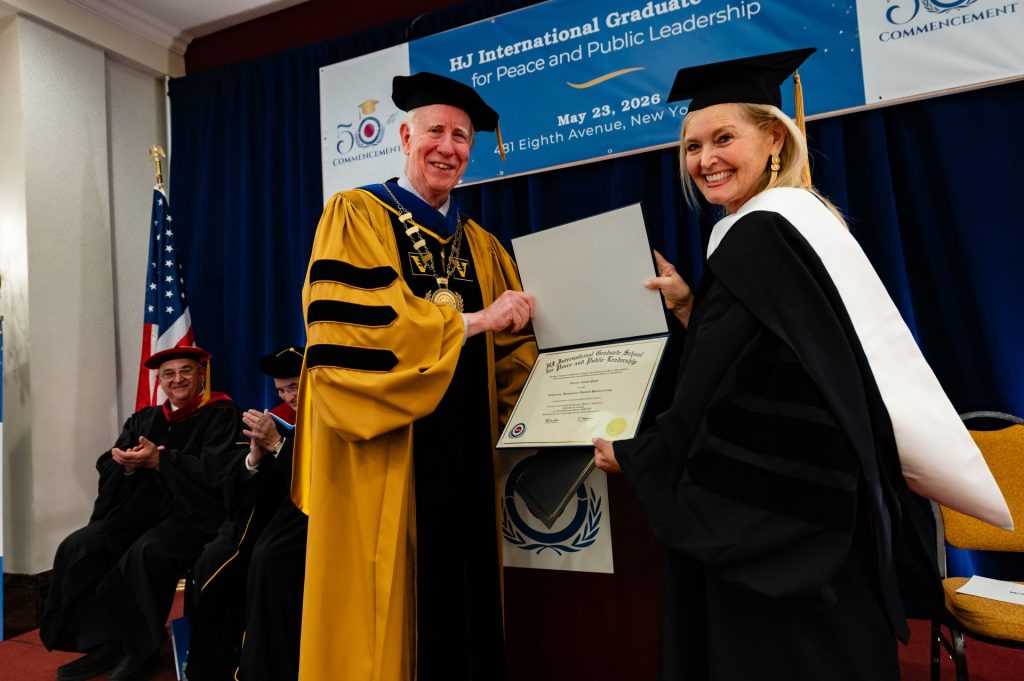
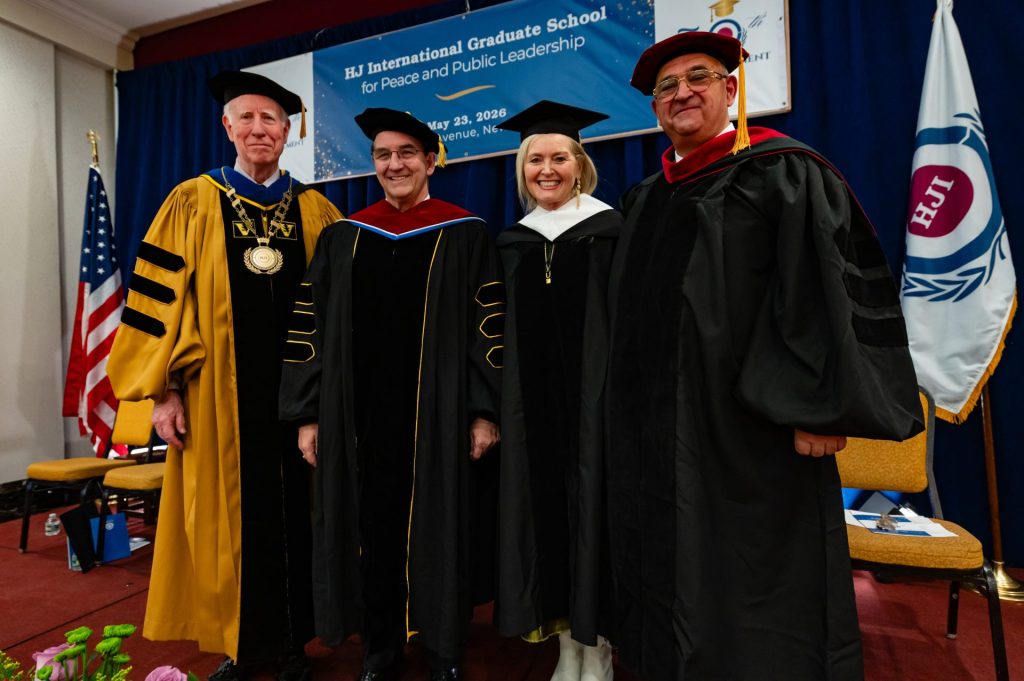
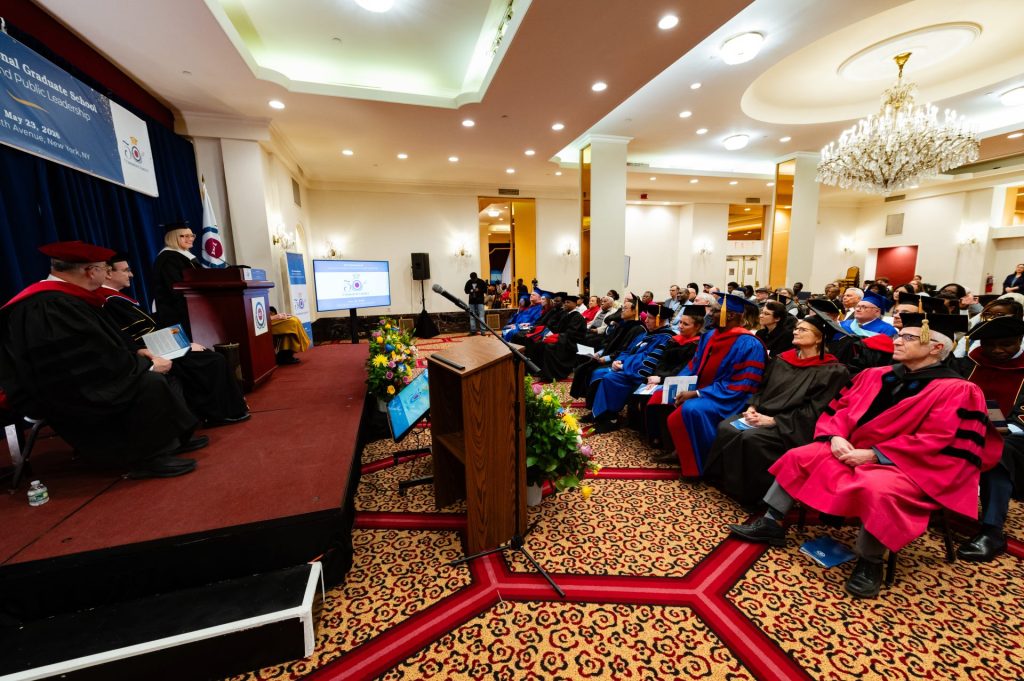
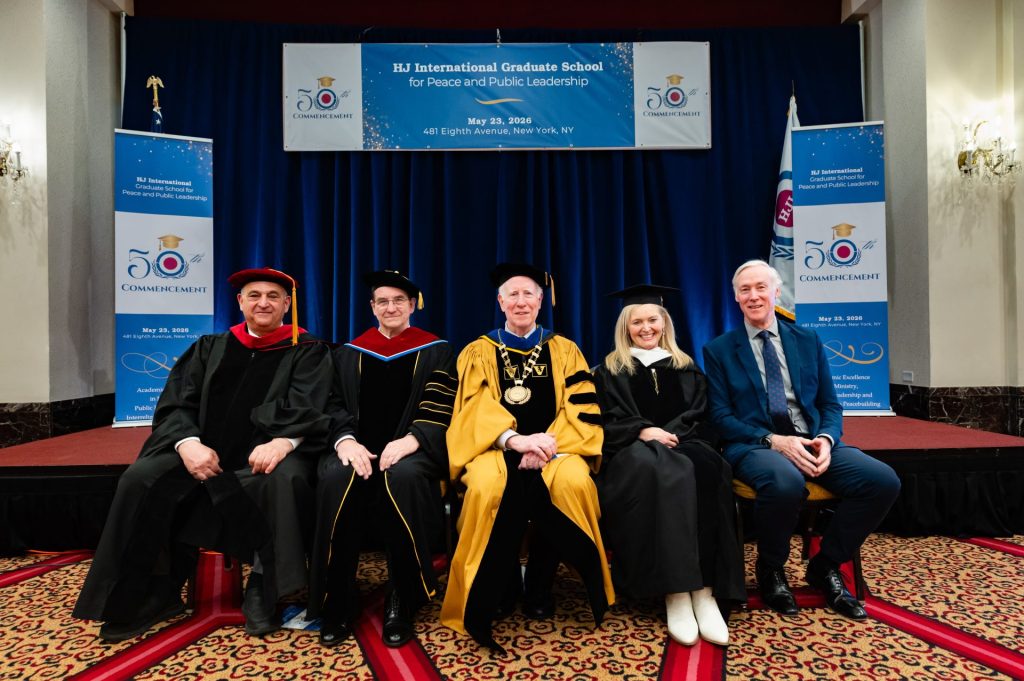
Dr. Katrina Lantos Swett was the recipient of an Honorary Doctorate during HJI’s 2026 Commencement Ceremonies held on May 23, 2026, at 481 Eighth Avenue, New York, NY.
What follows is the Commencement Address of Dr. Swett.
What a pleasure it is for me to be with you today and to receive an honorary doctorate from this wonderful institution. There are few moments in life as exhilarating, hopeful, and, yes, even a little bittersweet as a graduation ceremony. It is the occasion when intellectual passion, hard work, late nights, financial sacrifice, doubt and belief, ambition, and exhaustion all come together in a marvelous culminating achievement. Just a short time from now, with your diploma in hand, you will be able to exhale and, with a big smile and perhaps a pumped fist, say, “I did it!!!!” I promise to keep my remarks brief so that your glorious moment of triumph isn’t delayed much longer.
Giving a commencement address is different from other kinds of speeches because we all understand that graduation represents a hinge point in each of your lives. You are still connected to the past, but you are also ready to swing forward in exciting new directions. I hope that my few words today will give you a bit of added confidence and courage for the roads that lie ahead.
I want to begin today by noting the special mission of HJI, which sets it apart and gives a frame and meaning to the education you have pursued at this institution.
HJI’s commitment is to educate those who aspire to serve the world as transformational leaders in faith-based ministries or in fields related to religion, peace, and public leadership. Both the history and stated mission of this school are notable and lead me to my starting point for today’s remarks.
So let me begin with some good news! I would argue that all of you are starting this next phase of your life with a big part of the “job” of life already done! What do I mean by that?
Anciently, Socrates said, “The unexamined life is not worth living.” I agree wholeheartedly with that assertion. And yet today, so many people live their entire lives in the thick of thin things. They devote an absurd amount of time to the pursuit of the latest viral social media trends—TikTok, Instagram, doomscrolling. These are the emptiest of empty calories, and yet many of your peers spend way too much of their time consuming this material, which unsurprisingly, leaves them feeling profoundly unsatisfied and hungry for real meaning.
But for those of you who have chosen to study at HJI, I feel pretty confident in making the assumption that you get it that the questions and the quests that matter most in life are those that address themselves to the big and consequential queries: What do I believe about the question of where I came from? Why am I here? What is my ultimate destiny? And perhaps most importantly, what is the purpose of my life? These are big questions—I would even say these are the big questions.
And to the extent that you have already wrestled with them in your lives, I would say that you are way, way ahead in the game.
Now let me hasten to add that I get it that very few of us wake up each morning with these big questions uppermost in our minds. If you are like me, you of necessity spend plenty of time thinking about much more mundane matters: Did I remember to take the garbage out? Have I paid my most recent bills? Did I cancel that unwanted subscription? Did I pick up orange juice at the grocery store? Did I remember my mother’s birthday—never forget your mother’s birthday!!!!
Of course, if you happen to have children, the list of detailed daily things you have to juggle is truly endless—school, doctors’ appointments, homework, lunch money (maybe I’m dating myself with that one), sports, music lessons…. The list is never-ending (until they grow up).
Of course, these urgent, quotidian, immediate, and unavoidable matters press in on all of us every single day, and so it’s not like we get to spend our hours in thoughtful contemplation—hardly! But I truly believe that if you have taken the time and put in the real effort to find your answers to the big questions, you will have changed the course of your life for the better.
Grounding your life in the answers you have received to these questions means that underneath all the pressing matters of daily existence will be a hidden architecture of purpose and quiet conviction. This will give you a deep and abiding sense that you are on a worthy journey leading to a desired destination.
Without this strong hidden architecture, life, whatever its external attainments may be, is likely to feel hollow, brittle, and empty.
So, finding your answers to the big questions is step one, and it is indispensable—but I would argue that it is also insufficient.
You know, in ancient Greece, you could be extremely well educated, highly erudite, and in every way a thoroughly civilized member of the community, but you could still be called an idiot! Why? Because in ancient Greece, to be an idiot was to be someone who turned their back on the needs of the larger society around them. It was someone who chose only to concern themselves with their own private interests and had no involvement in the civic community of which they were a part. Ancient Athenians viewed civic engagement as a moral duty and, quite frankly, those who spurned such engagement were thought of as selfish “idiots”—a harsh judgement but perhaps a warranted one.
One of my absolute favorite movies of all time is Chariots of Fire, about two very different men who end up representing Great Britain in the 1924 Paris Olympics as runners. One is a Brilliant Jewish student at Cambridge, Harold Abraham, who feels that because of subtle discrimination and antisemitism in British society, he has a huge weight of responsibility to prove all the doubters and critics wrong. The other leading character is an aspiring Scottish minister and missionary named Eric Liddel, who feels called to serve in China but also senses that God wants him to use his great gift of speed to honor God, perhaps at the Olympics. They become both teammates and rivals on the British Olympic team—each facing their own obstacles and moral crises. As the promotional poster for the film says: “This is a story about two men who run—not to run but to prove something to the world. They will sacrifice everything to achieve their goals, except their honor.”
It’s a fantastic film, and I encourage all of you to watch it. You won’t regret it, and you will thank me for the recommendation!
The reason I bring up the movie is that in one of the early scenes, when Harold Abraham has just arrived at Cambridge to begin his studies, the master of the college speaks to the incoming class at a very fancy formal dinner. (Remember, this is after the First World War in which so many of the flowers of British youth were lost in the brutal trenches of the war.) The master’s remarks are as follows:
“I take the War List, and I run down it, name after name, which I cannot read, and which we, who are older than you, cannot hear without emotion. The flower of a generation, the glory of England, and they died for England, and now by tragic necessity, their dreams have become yours.” Here is the key part for you. He goes on: “Let me exhort you: examine yourselves. Let each of you discover where your true chance of greatness lies. For their sakes, for the sake of your college and your country, seize this chance, rejoice in it, and let no power or persuasion deter you in your task.”
As the students listen to these powerful words, you can see them taking in the call to find where their true chance to serve beyond themselves lies. The master of the college ties it into the sacrifice that others have made before them, giving added moral weight to his exhortation to “rejoice in their calling and to let no power or persuasion deter them from their task.”
I today would likewise exhort you to seek out the way in which you can use the talents and knowledge you have acquired to serve a greater purpose than your own advancement. Each of us has a true chance of greatness—not necessarily in the realm of worldly acclaim but in higher realms where it ultimately matters more. Let’s not have any Greek “idiots” in this wonderful group of graduates.
Finally, there is one last thought I would like to share with you today. Sometimes—not infrequently—fulfilling the call to a measure of greatness in life requires moral courage. Some of you are members of a faith community that has endured and continues to endure discrimination in various parts of the world, so you know what I mean when I talk about moral courage. It is not easy to live a life of integrity when one faces hostility and threats.
Many people have pondered the question: Where does moral courage come from? The Dutch historian Rutger Bregman has studied this rare but necessary quality that enables some people to overcome the very natural fear that we all contend with. Bregman has concluded that the thing that enables the desired courage is what he calls moral ambition—high and noble values wedded to ambition—a determination to actually do something. I really love the idea of linking our principles and beliefs to ambition. Ambition, of course, can be good or bad, but in the sense in which Bregman uses the word, he is referring to the driving force and sustained effort to achieve something.
He uses an interesting example to illustrate what he is talking about. It is a picture of hundreds and hundreds of workers at a Nazi shipbuilding plant in Germany in the 1930s. These workers are all giving the infamous Nazi salute—all except one man. In the middle of this screaming throng is one worker, quietly defiant with his arms crossed resolutely in front of him. Another image comes to my mind of the famous Tank Man in Tiananmen Square during the uprising in 1989. Both of these brave individuals had moral ambition. They were not satisfied with just thinking the right thoughts. They were determined to do something, and that determination fueled their courage.
I want to close by congratulating all of you on your wonderful achievements to date, and I am confident that, in the words of the poet Robert Browning, “The best is yet to be.” In 2018, when President George Herbert Walker Bush passed away, the Canadian Prime Minister Brian Mulroney recalled President Bush’s service as a Navy pilot in WWII and eulogized him with a familiar Navy aviator’s acronym, CAVU: Ceiling and visibility unlimited!
With your values and beliefs held close to your hearts, your commitment to serving others firmly anchored in your lives, and a healthy reserve of moral ambition to call upon if needed, I believe and hope for all of you that indeed the ceiling and visibility will be unlimited.
Thank you.

Dr. Katrina Lantos Swett serves as President of the Lantos Foundation for Human Rights and Justice, established in 2008 to continue the legacy of her father, the late Congressman Tom Lantos, who served as Chairman of the House Foreign Affairs Committee and was the only Holocaust survivor ever elected to the US Congress.
Under her leadership, the Lantos Foundation has become a distinguished and respected voice on key human rights issues ranging from advancing rule of law and freedom of religion and belief globally, to fighting for Internet freedom in closed societies, to combating the persistent and growing threat of antisemitism and Holocaust denial.
Dr. Lantos Swett is the former Chair and Vice Chair of the United States Commission on International Religious Freedom (USCIRF) and teaches courses on human rights and American foreign policy at Tufts University. She has served as Co-Chair of the International Religious Freedom Summit since its inaugural gathering in 2021.
She currently serves as Co-Chair of the Board of the Committee for Human Rights in North Korea (HRNK) and the Budapest-based Tom Lantos Institute, as well as on the Board of the Human Rights Foundation and Victims of Communism Memorial Foundation. Dr. Lantos Swett also serves on the Advisory Board of UN Watch, the annual Anne Frank Award and Lecture, and the Warren B. Rudman Center for Justice, Leadership and Public Policy.